


Page 14 - Seaward Safety
P. 14
Safe Condition

    Signage


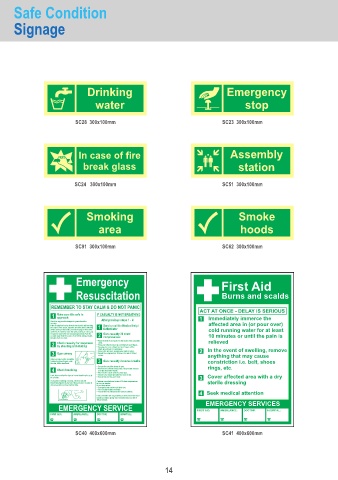
                       Drinking                          Emergency
                         water                                stop

                    SC28  300x100mm                     SC23  300x100mm


                     In case of fire                      Assembly
                      break glass                           station

                    SC24   300x100mm                    SC51  300x100mm


                      Smoking                               Smoke
                         area                                hoods

                    SC91  300x100mm                     SC62  300x100mm


                    Emergency                           First Aid
                    Resuscitation                       Burns and scalds
              REMEMBER TO STAY CALM & DO NOT PANIC
                                                   ACT AT ONCE - DELAY IS SERIOUS
               Make sure it is safe to  IF CASUALTY IS NOT BREATHING
               approach                            1  Immediately immerce the
                          After previous steps 1 - 4
              Check for any possible dangers to yourself and the
              casualty.                              affected area in (or pour over)
              If the casualty has had an electric shock and is still touching  Send or call for Medical help /
              the source of the shock, break the circuit by either switching
              off the current, at the mains, remove the plug or wrench the  Defibrillator   cold running water for at least
              cable free. If unable to reach the cable, socket, or mains, use
              or stand on some DRY non-conducting material. Push the  Give casualty 30 chest
              casualty away from the source of electricity, using a broom,  10 minutes or until the pain is
              wooden chair or a stool.  compressions
                         Place the heel of one hand over the centre of the casualties  relieved
               Check casualty for responses  chest.
                         Place your other hand on top and interlock your fingers.
               by shouting and shaking  Keeping your arms straight and your fingers off the
                         chest, press down 4-5 centimetres.  In the event of swelling, remove
                         Release the pressure, keeping your hands in place.  2
               Open airway  Repeat the compressions 30 times, at a rate of 100 per
                         minute.                     anything that may cause
              Using one hand on the casualties
              forehead and two fingers under  Give casualty 2 rescue breaths  constriction i.e. belt, shoes
              the chin, tilt the head back.
                         Ensure the casualties airway is open.  rings, etc.
               Check breathing  Pinch the nose firmly closed, take a deep breath and seal
                         your lips around the mouth.
                         Blow into the mouth until the chest rises.
              Look, listen and feel for signs of normal breathing for up to  Remove your mouth and allow the chest to fall.
              10 seconds.  Repeat this process once more.  3 Cover affected area with a dry
              If casualties breathing is normal, check for any life  Continue resuscitation at a rate of 30 chest compressions
              threatening injuries (if you have time) and place casualty in   to 2 rescue breaths.  sterile dressing
              recovery position and get medical help.   Do not stop unless:
                         Emergency help arrives and takes over.
                         The casualty breathes normally.
                         You become too exhausted and cannot continue.
                                                   4 Seek medical attention
                         If rescue breaths are not possible (i.e. there are severe facial
                         injuries), continue giving chest compressions at a rate of
                Recovery position
                         100 per minute.
                                                    EMERGENCY SERVICES
                EMERGENCY SERVICE                 FIRST AID:  AMBULANCE:  DOCTOR:  HOSPITAL:
             FIRST AID:  AMBULANCE:  DOCTOR:  HOSPITAL:
                    SC40  400x600mm                     SC41  400x600mm
                                          14

