


Page 157 - Seaward Safety
P. 157
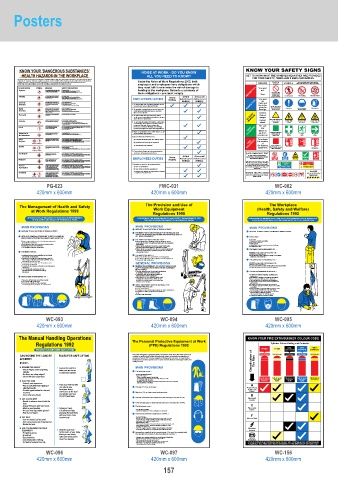
Posters
KNOW YOUR 'DANGEROUS SUBSTANCES' NOISE AT WORK - DO YOU KNOW KNOW YOUR SAFETY SIGNS
-HEALTH HAZARDS-IN THE WORKPLACE ALL YOU NEED TO KNOW? GET TO KNOW WHAT THE SYMBOLS MEAN THEY ARE PROVIDED
The Chemicals (Hazard Information and Packaging for Supply) Regulations 1994, aim to help protect people and the environment from the ill-effect FOR YOUR SAFETY, THERE ARE 5 MAIN CATEGORIES.
of chemicals. If a dangerous chemical is supplied in a package, it must be labelled and the chemicals packaged safely to withstand the conditions Under the Noise at Work Regulations 2005, both
ARE PUT INSIDE THE SAFETY SHAPE.
of supply and carriage. The prime function of supply labels is to warn and inform the user of both acute and chronic exposure hazards. MEANING SHAPE & SYMBOLS THESE ARE USED IN ALL EEC COUNTRIES.
KNOW WHAT THE LABELS MEAN - AND HOW TO HANDLE DANGEROUS SUBSTANCES SAFELY employers and employees have obligations which COLOR
they must fulfil to minimise the risk of damage to
CLASSIFICATION SYMBOL MEANING SAFETY PRECAUTIONS You must
Explosive May react exothermically without atmospheric 1. Use only as directed. hearing at the workplace. Below is a summary of PROHIBITION not.
oxygen, thereby quickly evolving gases, which
2. Keep container tightly closed, in cool well ventilated place.
may detonate, or upon heating explode. 3. Keep away from sources of heat and ignition. RED OUTLINE
these obligations - you must comply. Stop. CIRCLE WITH
4. This material and its container must be disposed of in a safe way.
CROSS BAR
Oxidizing Gives rise to highly exothermic reactions in 1. Use only as directed. At first At second means DO NOT No admittance No smoking No dirty clothes
2. Keep container tightly closed, in cool well ventilated place.
contact with other substances, particularly
flammable substances. 3. Keep away from sources of heat and ignition. Below
4. This material and its container must be disposed of in a safe way. EMPLOYERS DUTIES Action Level Action Level You must
80dB(A)
80dB(A) 85dB(A) do.
Extremely Liquids with extremely low flash points and 1. Keep container tightly closed. Carry out
2. Keep away from sources of heat and ignition.
low boiling points; gases which are flammable
flammable in contact with air at ambient temperature 3. Do not breathe vapour / spray. 1. To reduce the risk of hearing damage to the MANDATORY
and pressure. 4. Take precautionary measures against static discharges. the action
lowest level reasonably practicable. BLUE CIRCULAR
given by BACKGROUND
Highly Substances which may become hot and catch 1. Keep container tightly closed. 2. To appoint a competent person to carry out the sign. means OBEY Keep clear Head protection Wear gloves
fire in contact with air or a source of ignition;
must be worn
2. Keep away from sources of heat and ignition.
liquids with a very low flash point; substances
3. Do not breathe vapour / spray.
flammable which in contact with water or damp air, evolve 4. Take precautionary measures against static discharges. noise assessments and keep a record of
highly flammable gases. those assessments. Caution.
Flammable Liquid substances and preparations having a Keep away from sources of heat and ignition.
low flash point. 3. To reduce the risk of exposure to noise HAZARD/ Risk of
as far as is reasonably practicable by means danger.
other than ear protectors. WARNING YELLOW TRIANGLE
Corrosive Substances and preparations which, may on 1. Wear suitable gloves and eye / face protection. 4. To provide adequate information, instruction Hazard means risk of Danger high Danger mind Danger fork lifts
2. Take off all contaminated clothing immediately.
voltage
your head
in operation
contact with living tissues, destroy them.
ahead.
DANGER
3. In case of contact with skin, wash immediately with plenty of water.
4. In case of contact with eyes, rinse immediately (for 15 minutes) with plenty of water and training about risks to hearing, how to
and seek medical advice.
minimise that risk. How to obtain ear The safe
Irritant May cause inflammation of the skin or 1. In case of contact with eyes, rinse immediately with plenty of water and seek medical advice. protectors between 80dB(A) and 85dB(A) way.
2. In case of contact with skin, wash immediately with plenty of water.
mucous membrane through immediate,
prolonged or repeated contact. 3. Do not breathe vapour / spray / dust. and their obligations under the Regulations.
4. Avoid contact with skin. SAFE
CONDITION Where to
5. Mark ear protection zones with notices as far
Dangerous for Presents or may present an immediate, 1. Do not empty into drains. as reasonably practicable. go in an GREEN SQUARE/ First aid Escape Directional
RECTANGLE
or delayed danger for one or more parts
2. Keep away from food, drink and animal feeding stuffs.
the environment of the environment. 3. This material and its container must be disposed of in safe way. emergency. means GO station route arrow
6. Ensure that ear protectors are:-
Toxic/ Cause death or acute or chronic damage to 1. Wear suitable protective clothing, gloves and eye / face protection. a) provided to employees who ask for them. To indicate
health when inhaled, swallowed or absorbed
2. After contact with skin wash immediately with plenty of water.
3. In case of contact with eyes, rinse immediately with plenty of water and seek medical advice.
via the skin.
Very toxic the location
b) provided and used by all exposed. FIRE
4. In case of accident or you feel unwell, seek medical advice immediately.
Acute (Cat. 1-3) Acute (Cat. 4) EQUIPMENT of
RED SQUARE/
Harmful May cause death or acute or chronic damage 1. Do not breathe vapour / spray / dust. c) maintained and repaired. fire fighting RECTANGLE means Fire alarm Hose reel Fire
2. Avoid contact with skin.
to health when inhaled, swallowed or absorbed
via the skin. 3. Wash thoroughly before you eat, drink or smoke. equipment. extinguisher
4. In case of contact with eyes, rinse immediately with plenty of water and seek medical advice. FIRE FIGHTING
Acute (Cat. 1-3) Acute (Cat. 4) 7. Ensure that all who go into ear protection
zones are wearing ear protectors.
Carcinogenic May induce cancer or increase its 1. Wear suitable protective clothing, gloves and eye / face protection. SUPPLEMENTARY TEXT
incidence if inhaled, ingested or if it 2. Avoid contact with skin. In case of contact with skin, wash immediately with plenty of water.
penetrates the skin. 3. In case of contact with eyes, rinse immediately with plenty of water and seek medical advice. IF THE SAFETY SIGN NEEDS
4. In case of accident or you feel unwell, seek medical advice immediately. Below At first At second ADDITIONAL INFORMATION IT MAY No smoking Protective DANGER Smoking Fire alarm
EMPLOYEES DUTIES Action Level Action Level BE ADDED IN WORDS. beyond this point gloves must Fire risk area call point
May induce heritable genetic defects or
be worn
1. Wear suitable protective clothing, gloves and eye / face protection.
Mutagenic increase their incidence if inhaled, 2. Avoid contact with skin. In case of contact with skin, wash immediately with plenty of water. 80dB(A)
ingested or if it penetrates the skin. 3. In case of contact with eyes, rinse immediately with plenty of water and seek medical advice. 80dB(A) 85dB(A)
4. In case of accident or you feel unwell, seek medical advice immediately. MULTI-PURPOSE SIGNS
1. Employees must so far as practicable:- TO BE USED WHEN THE HAZARD
Toxic for Substances and preparations which, if they 1. Wear suitable protective clothing, gloves and eyes / face protection. a) Use ear protectors. REQUIRES MORE THAN ONE OF THE
2. Avoid contact with skin. In case of contact with skin, wash immediately with plenty of water.
are inhaled or ingested or if they penetrate
Reproduction the skin, may produce or increase the 3. In case of contact with eyes, rinse immediately with plenty of water and seek medical advice. 5 TYPES TO CONVEY THE SAFETY
incidence of non-heritable adverse effects
4. In case of accident or you feel unwell, seek medical advice immediately.
in the progeny and/or an impairment of male b) Use other protective equipment. MESSAGE.
or female reproductive functions or capacity.
c) Report any defects in equipment to his/her DANGER
Sensitising Substances and preparations which, if they 1. Wear suitable protective clothing, gloves and eyes / face protection. employer on discovery. WORKS TRAFFIC SIGNS GIVE IDENTIFICATION
are inhaled or if they penetrate the skin, are
2. Avoid contact with skin. In case of contact with skin, wash immediately with plenty of water.
capable of eliciting a reaction by 3. In case of contact with eyes, rinse immediately with plenty of water and seek medical advice. STOP 10 WAY
hyper-sensitisation such that on further 4. In case of accident or you feel unwell, seek medical advice immediately. ARE THE SAME DESIGN AS PUBLIC MARKING
exposure to the substance or preparation ROAD SIGNS.
Respiratory Dermal characteristic adverse effects are produced.
PG-023 FWC-031 WC-002
420mm x 600mm 420mm x 600mm 420mm x 600mm
The Management of Health and Safety The Provision and Use of The Workplace
at Work Regulations 1999 Work Equipment (Health, Safety and Welfare)
Regulations 1998 Regulations 1992
INTRODUCTION OF MEASURES TO ENCOURAGE IMPROVEMENTS CONCERNING THE MINIMUM HEALTH AND SAFETY REQUIREMENTS FOR CONCERNING THE MINIMUM HEALTH AND SAFETY REQUIREMENTS FOR THE WORKPLACE.
IN THE SAFETY AND HEALTH OF WORKERS AT WORK THE USE OF WORK EQUIPMENT BY WORKERS AT WORK THESE REGULATIONS WERE FULLY IMPLEMENTED ON THE 1ST OF JANUARY 1996.
MAIN PROVISIONS MAIN PROVISIONS MAIN PROVISIONS
APPLIES TO ALL SECTORS OF WORK ACTIVITY.
APPLIES TO ALL SECTORS OF WORK ACTIVITY. APPLIES TO MOST FIXED, PERMANENT WORKPLACES.
THE EMPLOYER IS RESPONSIBLE FOR THE HEALTH AND
SAFETY OF WORKERS REGARDING PROVISION AND USE OF
SETS OUT GENERAL PRINCIPLES TO BE FOLLOWED BY ALL WORK EQUIPMENT. EXCLUDES :-
EMPLOYERS IN PROTECTING HEALTH AND SAFETY BY :-
THE EMPLOYER MUST ENSURE THAT :- - Transport.
- Accessing workplace risks, introducing appropriate - Work equipment is suitable, properly adapted, can be - Temporary / mobile work sites.
preventative measures. used without risks to Health and Safety and is adequately - Extractive industries.
- Developing a coherent overall prevention policy. maintained. - Fishing boats.
- Agricultural or forestry land away from buildings.
- Adapting work to the individual. - Where Work equipment cannot be made totally safe, - Construction sites.
- Co-operation between employers. measures should be taken to minimise the risks.
- Where there is a specific risk, the use of work equipment THE EMPLOYEE IS REQUIRED TO :-
should be restricted to specified people who should be
THE EMPLOYER IS :- adequately trained.
- Maintain escape routes and emergency exits. WASTE
- Draw attention of the employer to faulty or unsuitable
- Assigned primary responsibility for the Health THE EMPLOYEE MUST :- - Maintain clean workplaces. BIN
and Safety of employees. - Take care of their own and other's work equipment. equipment and machinery.
- Required to designate competent personnel to - Draw to the attention of the employer, unsafe equipment.
take charge of Health and Safety activities or use - Co-operate with employers. THE EMPLOYER IS REQUIRED TO :-
competent outside services.
- To provide for First Aid. Fire Precautions and - Maintain escape routes and emergency exits.
Emergency Treatments. GENERAL PROVISIONS - Maintain clean workplaces.
- To provide information, instruction and training for MINIMUM REQUIREMENTS OF SPECIFIC HEALTH AND - Carry out maintenance and rectify faults as soon as possible.
employees. SAFETY HAZARDS WITH WHICH WORK EQUIPMENT - Regularly maintain and check safety equipment.
- To consult with employees or their MUST COMPLY.
representatives on Health and Safety - Control systems must be safe and breakdown OTHER REQUIREMENTS INCLUDE :-
measures.
or damage must not result in danger.
- Protection must exist against rupture or - Suitable and sufficient lighting, ventilation and
EMPLOYEES ARE REQUIRED TO :- disintegration of the equipment. temperature.
- Maintenance is to be possible when work
- Cleanliness of furniture, furnishings and fittings.
equipment is shut down or if this is not - Doors and gates fulfilling safety standards.
- Take care of their own and others safety. possible, to enable work to be carried out - The safe function of escalators and travelators.
- Co-operate with employers. without risk of danger. - Organisation of safe traffic routes for pedestrians
and vehicles.
- Draw to the attention of the employer - Suitable and sufficient sanitary conveniences.
unsafe equipment, machine, or environment. WORK EQUIPMENT MUST BE SUITABLE FOR - An adequate supply of drinking water to be readily
PREVENTING RISK OF:- accessible.
- Fire or overheating. - Accommodation for special clothing which is worn
- Discharge of gas, dust, liquid, vapour or other substances. by any person at work but is not taken home.
- Explosion of work equipment or substances - The availability of first aid equipment in all places
when working conditions require it.
in it. This equipment must be suitably marked.
- Contact with electricity. - Suitable and sufficient welfare facilities.
WC-093 WC-094 WC-095
420mm x 600mm 420mm x 600mm 420mm x 600mm
The Manual Handling Operations KNOW YOUR FIRE EXTINGUISHER COLOUR CODE
The Personal Protective Equipment at Work
Regulations 1992 (PPE) Regulations 1992 Cylinder Colour Coding and Contents
WATER FOAM CO 2 DRY WET
PREVENT INJURIES WITH SAFE LIFTING CARBON DIOXIDE POWDER CHEMICAL
Personal Protective Equipment (PPE) should be used when the risks cannot be Unsafe all voltages Unsafe all voltages Safe all voltages Safe all voltages Safe all voltages
CAN MOVING THE LOAD BE RULES FOR SAFE LIFTING avoided or sufficiently limited by technical means of collective protection or
AVOIDED? systems of work. PPE means equipment designed to be worn, or used by the
employee, to protect against one or more hazards likely to endanger health and
safety at work. Classification of Fire Risk
IF NOT:-
EXAMINE THE OBJECT 1 Assess the load first. MAIN PROVISIONS
- Check weight, centre of gravity, Make sure work area
stability. is clear from hazards. The Employer must :-
- Are there any sharp edges? - Assess the risks(s) posed.
- Check with your supervisor. - Select PPE which :- Safe for use on: Safe for use on: Safe all use on: Safe for use on: Safe for use on:
- Gives protection against the risks(s).
- Is suitable for the employee, including fitting correctly. Wood, Paper Flammable Flammable Flammable Oil and Fats
- Is compatible with the work.
PLAN THE TASK - Complies with the relevant European Community provisions on design Textiles etc. liquids liquids liquids
- Consult your supervisor. and manufacture - EC Mark.
- Plan a route free from tripping or 2 Keep your back upright A
slipping hazards. in a natural way, Provide PPE 'free of charge'. Paper, Wood,
- Provide opportunities for rest and bend your knees, Textile and
Fabric
stand close to the load
recovery. and spread your feet. Maintain PPE in clean, good working order.
- Know where to unload. DO NOT twist trunk. B
GET A GOOD GRIP Provide information and instruction and training in the use of PPE. Flammable
Liquids
- Decide in advance how to hold the
Involve Employees or their representatives in the selection of PPE.
load.
- Grasp firmly and with both hands. The Employee must :- C
- Attain a good posture. 3 Raise your head. - Use the PPE provided. Flammable
- Are you wearing suitable gloves? Lift using your legs, - Inform the employer if PPE is damaged or unsuitable. Gases
- Watch your fingers. grasping the load firmly General requirements applicable to all PPE :-
with your arms close
GET HELP to your body. - Design Principles. F
- PPE must be designed and manufactured so that the user can
- Can mechanical aid be used? perform the risk-related activity normally whilst possessing Oils and Fats
- Can someone else be of assistance? protection of the highest possible level.
- Effectiveness of PPE.
- Rotate the task. - PPE must be designed and manufactured as to prevent risks and
other nuisance factors, under foreseeable conditions of use.
- The PPE supplied must be suitable for all employees therefore
ARE YOU WEARING THE RIGHT - Comfort and Efficiency. Electrical
it should be adjustable or an adequate size range must exist.
EQUIPMENT? 4 Hold the load close Hazards
- Protective gloves. to the centre of your body. Information supplied by the manufacturer. PPE must be supplied with
the relevant information by the manufacturer such as :-
- A hard hat. When you are stable,
make sure work area is
- Eye protection. - Storage, use, cleaning, maintenance, servicing and disinfection. Vehicle
- What level of protection is provided by the PPE ?
- Overalls/durable clothing. clear from hazards - What accessories or spare parts exist ? Protection
- Protective footwear/non-slip. - The expiry date of the PPE or certain of its components. COLOUR CODING IN ACCORDANCE WITH BS EN3: 1996 - PORTABLE FIRE EXTINGUISHERS
- What type of packaging is suitable for transport ?
- The significance of any markings. FLAMMABLE GAS FIRES MUST BE EXTINGUISHED BY THE EMERGENCY SERVICES ONLY
WC-096 WC-097 WC-156
420mm x 600mm 420mm x 600mm 420mm x 600mm
157

