


Page 158 - Seaward Safety
P. 158
Posters


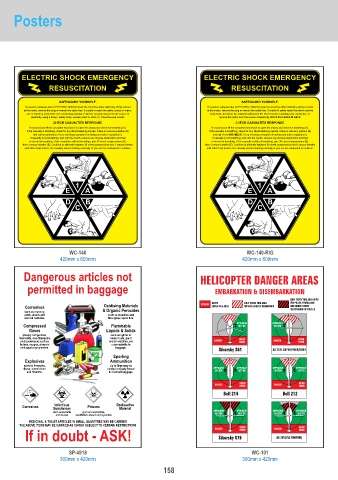
      ELECTRIC SHOCK EMERGENCY                      ELECTRIC SHOCK EMERGENCY
             RESUSCITATION                                RESUSCITATION

                SAFEGUARD YOURSELF.                          SAFEGUARD YOURSELF.
       If a person collapses due to ELECTRIC SHOCK break the circuit by either switching off the current  If a person collapses due to ELECTRIC SHOCK break the circuit by either switching off the current
       at the mains, remove the plug or wrench the cable free. If unable to reach the cable, socket or mains,  at the mains, remove the plug or wrench the cable free. If unable to safely reach the switch use the
        use or stand on some DRY non-conducting material. Push the casualty away from the source of  body hook, (found on the forward bulkhead of the SCR Room) or anything non-conductive, to
         electricity, using a broom, safety hook, wooden chair or stool (1). Once the area is safe:  remove the victim from the source of electricity, ONCE THE AREA IS SAFE.
              CHECK CASUALTIES RESPONSE.                   CHECK CASUALTIES RESPONSE.
        If unconscious tilt the casualty's head back to open the airway and check for breathing (A).  If unconscious tilt the casualty's head back to open the airway and check for breathing (A).
        If the casualty is breathing, check for any life-threatening injuries. Place in recovery position (B)  If the casualty is breathing, check for any life-threatening injuries. Place in recovery position (B)
         and call an ambulance. Keep checking casualty's breathing and pulse regularly (C).  and call for the RIG MEDIC. Keep checking casualty's breathing and pulse regularly (C).
         If casualty is not breathing, look into the mouth, remove any obvious obstruction and then   If casualty is not breathing, look into the mouth, remove any obvious obstruction and then
        re-check for breathing. If the casualty is still not breathing, give 30 chest compressions (D),  re-check for breathing. If the casualty is still not breathing, give 30 chest compressions (D),
       then 2 rescue breaths (E). Continue to alternate between 30 chest compressions and 2 rescue breaths  then 2 rescue breaths (E). Continue to alternate between 30 chest compressions and 2 rescue breaths
       until either help arrives, the casualty starts breathing normally or you are too exhausted to continue.  until either help arrives, the casualty starts breathing normally or you are too exhausted to continue.


                  WC-140                                      WC-140-RIG
                420mm x 600mm                                420mm x 600mm
       Dangerous articles not                      HELICOPTER DANGER AREAS
        permitted in baggage                          EMBARKATION & DISEMBARKATION
                                                                         ONLY ENTER THIS AREA WITH
                                                      NEVER   ONLY ENTER THIS AREA  THE PILOTS PERMISSION
                                                   DANGER
       Corrosives          Oxidising Materials        ENTER THIS AREA  WITH THE PILOTS PERMISSION  AND UNDER STRICT
                                                                         SUPERVISION OF THE HLO
       such as mercury,   & Organic Peroxides
       acids, alkalis and   such as bleaches and
       wet cell batteries.  fibre glass repair kits.
                                                            APPROACH  APPROACH
       Compressed            Flammable                      SECTOR   SECTOR
        Gases              Liquids & Solids
       (deeply refrigerated,  such as lighter or
      flammable, non-flammable  heater fuels, paint         NEVER          NEVER
      and posionous) such as  and all matches, are    DANGER  ENTER  DANGER  ENTER
      butane, oxygen, propane  unacceptable in
      and aqualung cylinders.  baggage.
                                                       Sikorsky S61  AS 332L SUPER PUMA/TIGER
                             Sporting
       Explosives           Ammunition
       such as fireworks,   Up to 5kgs may be
       flares, ammunition   carried properly boxed    APPROACH  APPROACH  APPROACH  APPROACH
        and firearms.       in checked baggage.       SECTOR  SECTOR  SECTOR  SECTOR
                                                            NEVER          NEVER
                                                      DANGER         DANGER
                                                            ENTER          ENTER
                                                         Bell 214      Bell 212
       Corrosives  Infectious  Poisons  Radioactive
              Substances       Material
              such as bacteria  such as insecticides,  APPROACH  APPROACH  APPROACH  APPROACH
                                                            SECTOR
                                                                           SECTOR
                                                                     SECTOR
                                                      SECTOR
               and viruses  weedkillers, arsenic and cyanides
        MEDICINAL & TOILET ARTICLES IN SMALL QUANTITIES MAY BE CARRIED
      THE ABOVE ITEMS MAY BE CARRIED AS CARGO SUBJECT TO CERTAIN RESTRICTIONS  NEVER  NEVER
                                                      DANGER  ENTER  DANGER  ENTER
       If in doubt - ASK!                              Sikorsky S76   AS 365N/N2 DAUPHIN
                  SP-4918                                      WC-101
                300mm x 420mm                                300mm x 420mm
                                          158

