


Page 164 - Seaward Safety | Supplying Signage Solutions
P. 164
Posters                                                     *  All information can be tailored
                                                                    to suit requirements


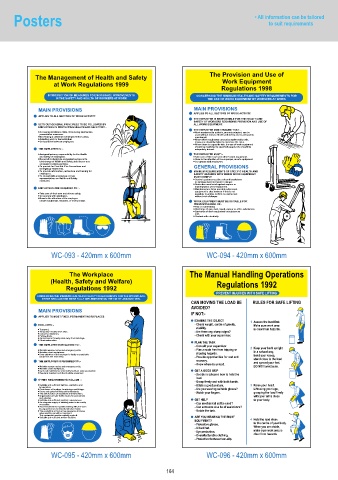
                                                     The Provision and Use of
          The Management of Health and Safety
              at Work Regulations 1999                  Work Equipment
                                                        Regulations 1998
             INTRODUCTION OF MEASURES TO ENCOURAGE IMPROVEMENTS  CONCERNING THE MINIMUM HEALTH AND SAFETY REQUIREMENTS FOR
               IN THE SAFETY AND HEALTH OF WORKERS AT WORK    THE USE OF WORK EQUIPMENT BY WORKERS AT WORK
           MAIN PROVISIONS                       MAIN PROVISIONS
                                                 APPLIES TO ALL SECTORS OF WORK ACTIVITY.
           APPLIES TO ALL SECTORS OF WORK ACTIVITY.
                                                 THE EMPLOYER IS RESPONSIBLE FOR THE HEALTH AND
                                                 SAFETY OF WORKERS REGARDING PROVISION AND USE OF
           SETS OUT GENERAL PRINCIPLES TO BE FOLLOWED BY  ALL WORK EQUIPMENT.
           EMPLOYERS IN PROTECTING HEALTH AND SAFETY BY :-
                                                 THE EMPLOYER MUST ENSURE THAT :-
           - Accessing workplace risks, introducing appropriate  - Work equipment is suitable, properly adapted, can be
             preventative measures.                used without risks to Health and Safety and is adequately
           - Developing a coherent overall prevention policy.    maintained.
           - Adapting work to the individual.    - Where Work equipment cannot be made totally safe,
           - Co-operation between employers.       measures should be taken to minimise the risks.
                                                 - Where there is a specific risk, the use of work equipment
                                                   should be restricted to specified people who should be
           THE EMPLOYER IS :-                      adequately trained.
           - Assigned primary responsibility for the Health   THE EMPLOYEE MUST :-
             and Safety of employees.            - Take care of their own and other's work equipment.
           - Required to designate competent personnel to  - Draw to the attention of the employer, unsafe equipment.
             take charge of Health and Safety activities or use  - Co-operate with employers.
             competent outside services.
           - To provide for First Aid. Fire Precautions and  GENERAL PROVISIONS
             Emergency Treatments.
           - To provide information, instruction and training for  MINIMUM REQUIREMENTS OF SPECIFIC HEALTH AND
             employees.                          SAFETY HAZARDS WITH WHICH WORK EQUIPMENT
           - To consult with employees or their  MUST COMPLY.
             representatives on Health and Safety
             measures.                           - Control systems must be safe and breakdown
                                                   or damage must not result in danger.
                                                 - Protection must exist against rupture or
                                                   disintegration of the equipment.
           EMPLOYEES ARE REQUIRED TO :-
                                                 - Maintenance is to be possible when work
                                                   equipment is shut down or if this is not
           - Take care of their own and others safety.    possible, to enable work to be carried out
           - Co-operate with employers.            without risk of danger.
           - Draw to the attention of the employer
             unsafe equipment, machine, or environment.  WORK EQUIPMENT MUST BE SUITABLE FOR
                                                 PREVENTING RISK OF:-
                                                 - Fire or overheating.
                                                 - Discharge of gas, dust, liquid, vapour or other substances.
                                                 - Explosion of work equipment or substances
                                                   in it.
                                                 - Contact with electricity.

              WC-093 - 420mm x 600mm                WC-094 - 420mm x 600mm
                  The Workplace                 The Manual Handling Operations
              (Health, Safety and Welfare)             Regulations 1992
                 Regulations 1992
                                                       PREVENT INJURIES WITH SAFE LIFTING
          CONCERNING THE MINIMUM HEALTH AND SAFETY REQUIREMENTS FOR THE WORKPLACE.
           THESE REGULATIONS WERE FULLY IMPLEMENTED ON THE 1ST OF JANUARY 1996.
                                                CAN MOVING THE LOAD BE  RULES FOR SAFE LIFTING
                                                AVOIDED?
           MAIN PROVISIONS
                                                IF NOT:-
           APPLIES TO MOST FIXED, PERMANENT WORKPLACES.
                                                 EXAMINE THE OBJECT  1  Assess the load first.
           EXCLUDES :-                           - Check weight, centre of gravity,  Make sure work area
                                                   stability.
           - Transport.                                         is clear from hazards.
           - Temporary / mobile work sites.      - Are there any sharp edges?
           - Extractive industries.
           - Fishing boats.                      - Check with your supervisor.
           - Agricultural or forestry land away from buildings.
           - Construction sites.
                                                 PLAN THE TASK
           THE EMPLOYEE IS REQUIRED TO :-        - Consult your supervisor.
           - Maintain escape routes and emergency exits.  - Plan a route free from tripping or  2  Keep your back upright
           - Maintain clean workplaces.  WASTE     slipping hazards.  in a natural way,
                                  BIN
           - Draw attention of the employer to faulty or unsuitable
             equipment and machinery.            - Provide opportunities for rest and  bend your knees,
           THE EMPLOYER IS REQUIRED TO :-          recovery.    stand close to the load
                                                                and spread your feet.
                                                 - Know where to unload.
           - Maintain escape routes and emergency exits.        DO NOT twist trunk.
           - Maintain clean workplaces.
           - Carry out maintenance and rectify faults as soon as possible.  GET A GOOD GRIP
           - Regularly maintain and check safety equipment.
                                                 - Decide in advance how to hold the
                                                   load.
           OTHER REQUIREMENTS INCLUDE :-
                                                 - Grasp firmly and with both hands.
           - Suitable and sufficient lighting, ventilation and   - Attain a good posture.  3  Raise your head.
             temperature.
           - Cleanliness of furniture, furnishings and fittings.  - Are you wearing suitable gloves?  Lift using your legs,
           - Doors and gates fulfilling safety standards.
           - The safe function of escalators and travelators.  - Watch your fingers.  grasping the load firmly
           - Organisation of safe traffic routes for pedestrians   with your arms close
             and vehicles.
           - Suitable and sufficient sanitary conveniences.  GET HELP  to your body.
           - An adequate supply of drinking water to be readily  - Can mechanical aid be used?
             accessible.
           - Accommodation for special clothing which is worn  - Can someone else be of assistance?
             by any person at work but is not taken home.
           - The availability of first aid equipment in all places  - Rotate the task.
             when working conditions require it.
             This equipment must be suitably marked.
           - Suitable and sufficient welfare facilities.  ARE YOU WEARING THE RIGHT  4  Hold the load close
                                                 EQUIPMENT?
                                                 - Protective gloves.  to the centre of your body.
                                                 - A hard hat.  When you are stable,
                                                 - Eye protection.  make sure work area is
                                                                clear from hazards
                                                 - Overalls/durable clothing.
                                                 - Protective footwear/non-slip.
              WC-095 - 420mm x 600mm                WC-096 - 420mm x 600mm
                                          164

