


Page 162 - Seaward Safety | Supplying Signage Solutions
P. 162
Posters                                                     *  All information can be tailored
                                                                    to suit requirements


          ELECTRIC SHOCK EMERGENCY              ELECTRIC SHOCK EMERGENCY
                 RESUSCITATION                         RESUSCITATION

                   SAFEGUARD YOURSELF.                    SAFEGUARD YOURSELF.
           If a person collapses due to ELECTRIC SHOCK break the circuit by either switching off the current  If a person collapses due to ELECTRIC SHOCK break the circuit by either switching off the current
          at the mains, remove the plug or wrench the cable free. If unable to reach the cable, socket or mains,  at the mains, remove the plug or wrench the cable free. If unable to safely reach the switch use the
           use or stand on some DRY non-conducting material. Push the casualty away from the source of  body hook, (found on the forward bulkhead of the SCR Room) or anything non-conductive, to
            electricity, using a broom, safety hook, wooden chair or stool (1). Once the area is safe:  remove the victim from the source of electricity, ONCE THE AREA IS SAFE.
                  CHECK CASUALTIES RESPONSE.            CHECK CASUALTIES RESPONSE.
            If unconscious tilt the casualty's head back to open the airway and check for breathing (A).  If unconscious tilt the casualty's head back to open the airway and check for breathing (A).
           If the casualty is breathing, check for any life-threatening injuries. Place in recovery position (B)  If the casualty is breathing, check for any life-threatening injuries. Place in recovery position (B)
             and call an ambulance. Keep checking casualty's breathing and pulse regularly (C).  and call for the RIG MEDIC. Keep checking casualty's breathing and pulse regularly (C).
             If casualty is not breathing, look into the mouth, remove any obvious obstruction and then   If casualty is not breathing, look into the mouth, remove any obvious obstruction and then
            re-check for breathing. If the casualty is still not breathing, give 30 chest compressions (D),  re-check for breathing. If the casualty is still not breathing, give 30 chest compressions (D),
          then 2 rescue breaths (E). Continue to alternate between 30 chest compressions and 2 rescue breaths  then 2 rescue breaths (E). Continue to alternate between 30 chest compressions and 2 rescue breaths
           until either help arrives, the casualty starts breathing normally or you are too exhausted to continue.  until either help arrives, the casualty starts breathing normally or you are too exhausted to continue.


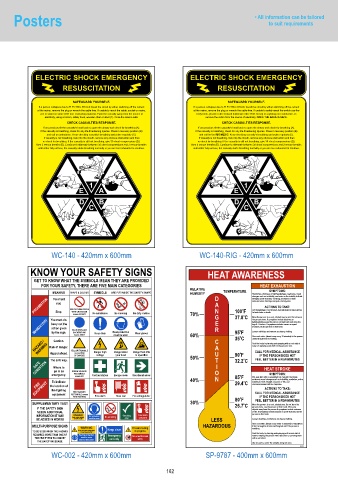
              WC-140 - 420mm x 600mm               WC-140-RIG - 420mm x 600mm

         KNOW YOUR SAFETY SIGNS                      HEAT AWARENESS
         GET TO KNOW WHAT THE SYMBOLS MEAN THEY ARE PROVIDED
           FOR YOUR SAFETY, THERE ARE FIVE MAIN CATEGORIES        HEAT EXHAUSTION
                                                RELATIVE
                                                                    SYMPTOMS:
              MEANING  SHAPE & COLOUR  SYMBOLS  ARE PUT INSIDE THE SAFETY SHAPE  HUMIDITY  D  TEMPERATURE  Headaches; dizziness or lightheadedness; weakness; mood
                                                                changes such as irritability, confusion or the inability to think
                                                                straight; upset stomach; vomiting; decreased or dark
         PROHIBITION  You must  RED OUTLINE CIRCLE    A      o  coloured urine; fainting; and pale, clammy skin.
               not.
                                                                   ACTIONS TO TAKE:
                                                                Act immediately: If not treated, heat exhaustion may advance
               Stop.
                   WITH CROSS BAR
                   means DO NOT  No admittance  No smoking  No dirty clothes  70%  N  100 F o  to heat stroke or death.
                                                      G
                                                           37.8 C
                                                                Move the person: to a cool, shaded area to rest. Do not leave
         MANDATORY You must do.  BLUE CIRCULAR  Keep clear  Head protection  Wear gloves  60%  E R  95 F  lightheadedness, lay the person on their back and raise the
                                                                the person alone. If symptoms include dizziness or
              Carry out the
                                                                legs 6 - 8 inches. If symptoms include nausea or upset
                                                                stomach, lay the person on their side.
              action given
                                                             o
                                                                Loosen clothing: and remove any heavy clothing
                   BACKGROUND
              by the sign.
                             must be worn
                   means OBEY
                                                                Give cool water: (about a cup every 15 minutes) to the person
                                                             o
              Caution.
          HAZARD /  Risk of  danger .  YELLOW TRIANGLE  C  35 C  unless the person is vomiting.
                                                                Cool the body: by fanning and spraying with a cool mist of
          WARNING
                                                                water or applying a wet cloth to the persons skin.
                                                      A
                    means RISK
                 ahead
             Hazard
                                                             o
                  .
                                                                 IF THE PERSON DOES NOT
                                   in operation
                         voltage
                              your head
                   OF DANGER  Danger high  Danger mind   Danger fork lifts  50%  U  90 F  CALL FOR MEDICAL ASSISTANCE
                                                             o
              The safe way.                           T    32.2 C  FEEL BETTER IN A FEW MINUTES
          CONDITION  Where to  GREEN SQUARE /         O I          HEAT STROKE
          SAFE
              go in an
                   RECTANGLE
                                                                    SYMPTOMS:
              emergency.
                                                             o
                             Escape route
                        First aid station
                                  Directional arrow
                    means GO
                                                                sunburnt; mood changes such as irritability, confusion, or the
                                                40%   N    85 F o  Dry, pale skin with no sweating; hot, red skin that looks
              To indicate
          EQUIPMENT  the location of  RED SQUARE /                 ACTIONS TO TAKE:
                                                                inability to think straight; seizures or fits; and
                                                           29.4 C
          FIRE
                                                                unconsciousness with no response.
              fire fighting
              equipment
                   RECTANGLE means
                                                                 IF THE PERSON DOES NOT
                   FIRE FIGHTING  Fire alarm  Hose reel  Fire extinguisher  CALL FOR MEDICAL ASSISTANCE
                                                             o
                                                           80 F  FEEL BETTER IN A FEW MINUTES
         SUPPLEMENTARY TEXT                     30%        26.7 C  Move the person: to a cool, shaded area. Do not leave the
                                                             o
                                                                person alone. Lay the person on their back. Move any
          IF THE SAFETY SIGN                                    objects away from the person if symptoms include seizures
          NEEDS ADDITIONAL                                      or fits. If symptoms include nausea or upset stomach, lay the
                                                                person on their side.
          INFORMATION IT MAY  DANGER  Ear protection  Smoking  Fire alarm
                   Panel contains isolated  No smoking  area  call point
          BE ADDED IN WORDS  and LIVE circuits  must be worn  LESS  Loosen clothing: and remove any heavy clothing.
                                                                Give cool water: (about a cup every 15 minutes) to the person
         MULTI-PURPOSE SIGNS                       HAZARDOUS    if alert enough to drink something but not if the person is
                     WARNING      Pressure testing              vomiting.
                    Crane operations taking place  Keep clear
         TO BE USED WHEN THE HAZARD  Do not cross barrier  in progress  Cool the body: by fanning and spraying with a cool mist of
         REQUIRES MORE THAN ONE OF  Hearing protection  Emergency  No unauthorised  water or wiping the person with a wet cloth or covering them
                     must be worn
          THE FIVE TYPES TO CONVEY  beyond this point  exit only  entry  with a wet sheet.
          THE SAFETY MESSAGE.                                   Use ice packs: under the armpits and groin area.
                                                                           SP9787
              WC-002 - 420mm x 600mm                SP-9787 - 400mm x 600mm
                                          162

