


Page 163 - Seaward Safety | Supplying Signage Solutions
P. 163
Posters                                                     *  All information can be tailored
                                                                    to suit requirements


          Dangerous articles not                KNOW YOUR FIRE EXTINGUISHER COLOUR CODE
                                                         Cylinder Colour Coding and Contents
           permitted in baggage                       WATER  FOAM  CARBON DIOXIDE  POWDER  CHEMICAL
                                                                          WET
                                                                     DRY
                                                                CO 2
           Corrosives         Oxidising Materials    Unsafe all voltages  Unsafe all voltages  Safe all voltages  Safe all voltages   Safe all voltages
           such as mercury,   & Organic Peroxides  Classification of  Fire Risk
          acids, alkalis and   such as bleaches and
          wet cell batteries.  fibre glass repair kits.
          Compressed            Flammable
            Gases              Liquids & Solids
          (deeply refrigerated,  such as lighter or
         flammable, non-flammable  heater fuels, paint  Safe for use on:  Safe for use on:  Safe all use on:  Safe for use on:  Safe for use on:
                                                                         Oil and Fats
                                                                    Flammable
                                                     Wood, Paper
                                                          Flammable
                                                               Flammable
         and posionous) such as  and all matches, are  Textiles etc.  liquids  liquids  liquids
         butane, oxygen, propane  unacceptable in
                                                 A
         and aqualung cylinders.  baggage.
                                                Paper, Wood,
                                 Sporting       Textile and
           Explosives           Ammunition       Fabric
          such as fireworks,    Up to 5kgs may be  B
          flares, ammunition   carried properly boxed  Flammable
           and firearms.       in checked baggage.  Liquids
                                                 C
                                                Flammable
                                                 Gases
                                                  F
                                                Oils and Fats
                  Infectious     Radioactive
          Corrosives      Poisons
                  Substances      Material
                  such as bacteria  such as insecticides,
                  and viruses  weedkillers, arsenic and cyanides
                                                 Electrical
            MEDICINAL & TOILET ARTICLES IN SMALL QUANTITIES MAY BE CARRIED  Hazards
         THE ABOVE ITEMS MAY BE CARRIED AS CARGO SUBJECT TO CERTAIN RESTRICTIONS
           If in doubt - ASK!                   COLOUR CODING IN ACCORDANCE WITH BS EN3: 1996 - PORTABLE FIRE EXTINGUISHERS
                                                 Vehicle
                                                Protection
                                                FLAMMABLE GAS FIRES MUST BE EXTINGUISHED BY THE EMERGENCY SERVICES ONLY
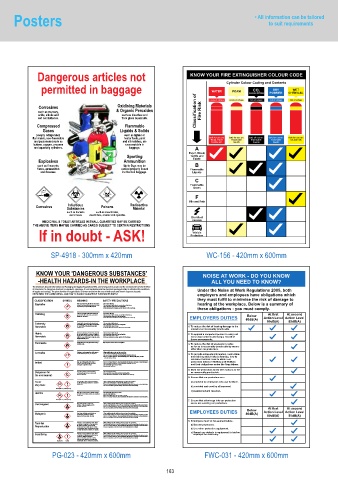
              SP-4918 - 300mm x 420mm               WC-156 - 420mm x 600mm
          KNOW YOUR 'DANGEROUS SUBSTANCES'         NOISE AT WORK - DO YOU KNOW
          -HEALTH HAZARDS-IN THE WORKPLACE            ALL YOU NEED TO KNOW?
         The Chemicals (Hazard Information and Packaging for Supply) Regulations 1994, aim to help protect people and the environment from the ill-effect
         of chemicals. If a dangerous chemical is supplied in a package, it must be labelled and the chemicals packaged safely to withstand the conditions
         of supply and carriage. The prime function of supply labels is to warn and inform the user of both acute and chronic exposure hazards.  Under the Noise at Work Regulations 2005, both
         KNOW WHAT THE LABELS MEAN - AND HOW TO HANDLE DANGEROUS SUBSTANCES SAFELY  employers and employees have obligations which
                                                  they must fulfil to minimise the risk of damage to
          CLASSIFICATION        SYMBOL            MEANING                       SAFETY PRECAUTIONS
          Explosive  May react exothermically without  atmospheric  1. Use only as directed.  hearing at the workplace. Below is a summary of
                    oxygen, thereby quickly evolving gases, which  2. Keep container tightly closed, in cool well ventilated place.
                    may detonate, or upon heating explode.  3. Keep away from sources of heat and ignition.
                           4. This material and its container must be disposed of in a safe way.
                                                  these obligations - you must comply.
          Oxidizing  Gives rise to highly exothermic reactions in   1. Use only as directed.  At first  At second
                    contact with other substances, particularly
                           2. Keep container tightly closed, in cool well ventilated place.
                    flammable substances.   3. Keep away from sources of heat and ignition.  Below
                           4. This material and its container must be disposed of in a safe way.  EMPLOYERS DUTIES   80dB(A)   Action Level Action Level
                                                                   80dB(A)   85dB(A)
          Extremely  low boiling points; gases which are flammable   2. Keep away from sources of heat and ignition.
                    Liquids with extremely low flash points and
                           1. Keep container tightly closed.
          flammable  in contact with air at ambient temperature   3. Do not breathe vapour / spray.  1. To reduce the risk of hearing damage to the
                           4. Take precautionary measures against static discharges.
                    and pressure.
                                                    lowest level reasonably practicable.

          Highly    fire in contact with air or a source of ignition;  2. Keep away from sources of heat and ignition.  2. To appoint a competent person to carry out
                           1. Keep container tightly closed.
                    Substances which may become hot and catch
          flammable  liquids with a very low flash point; substances   3. Do not breathe vapour / spray.      noise assessments and keep a record of
                           4. Take precautionary measures against static discharges.
                    which in contact with water or damp air, evolve
                    highly flammable gases.
                                                    those assessments.
          Flammable  Liquid substances and preparations having a   Keep away from sources of heat and ignition.        3. To reduce the risk of exposure to noise
                    low flash point.
                                                    as far as is reasonably practicable by means
                                                    other than ear protectors.
          Corrosive  Substances and preparations which, may on  1. Wear suitable gloves and eye / face protection.        4. To provide adequate information, instruction
                           2. Take off all contaminated clothing immediately.
                    contact with living tissues, destroy them.
                           3. In case of contact with skin, wash immediately with plenty of water.
                           4. In case of contact with eyes, rinse immediately (for 15 minutes) with plenty of water      and training about risks to hearing, how to
                               and seek medical advice.
                                                    minimise that risk. How to obtain ear
          Irritant  May cause inflammation of the skin or   1. In case of contact with eyes, rinse immediately with plenty of water and seek medical advice.      protectors between 80dB(A) and 85dB(A)
                           2. In case of contact with skin, wash immediately with plenty of water.
                    mucous membrane through immediate,
                    prolonged or repeated contact.       3. Do not breathe vapour / spray / dust.      and their obligations under the Regulations.
                           4. Avoid contact with skin.
                                                5. Mark ear protection zones with notices as far
          Dangerous for  Presents or may present an immediate,  1. Do not empty into drains.      as reasonably practicable.
                    or delayed danger for one or more parts
                           2. Keep away from food, drink and animal feeding stuffs.
          the environment  of the environment.  3. This material and its container must be disposed of in safe way.
                                                6. Ensure that ear protectors are:-

                    Cause death or acute or chronic damage to
          Toxic/    health when inhaled, swallowed or absorbed  2. After contact with skin wash immediately with plenty of water.      a) provided to employees who ask for them.
                           1. Wear suitable protective clothing, gloves and eye / face protection.
          Very toxic  via the skin.  3. In case of contact with eyes, rinse immediately with plenty of water and seek medical advice.
                           4. In case of accident or you feel unwell, seek medical advice immediately.      b) provided and used by all exposed.
               Acute (Cat. 1-3) Acute (Cat. 4)
                                                    c) maintained and repaired.
          Harmful   to health when inhaled, swallowed or absorbed  2. Avoid contact with skin.
                           1. Do not breathe vapour / spray / dust.
                    May cause death or acute or chronic damage
                    via the skin.   3. Wash thoroughly before you eat, drink or smoke.
                           4. In case of contact with eyes, rinse immediately with plenty of water and seek medical advice.
               Acute (Cat. 1-3) Acute (Cat. 4)
                                                7. Ensure that all who go into ear protection
          Carcinogenic  May induce cancer or increase its   1. Wear suitable protective clothing, gloves and eye / face protection.      zones are wearing ear protectors.
                    incidence if inhaled, ingested or if it   2. Avoid contact with skin. In case of contact with skin, wash immediately with plenty of water.
                    penetrates the skin.  3. In case of contact with eyes, rinse immediately with plenty of water and seek medical advice.
                           4. In case of accident or you feel unwell, seek medical advice immediately.  At first  At second
                                                              Below
                                                EMPLOYEES DUTIES   Action Level Action Level
          Mutagenic  May induce heritable genetic defects or  1. Wear suitable protective clothing, gloves and eye / face protection.  80dB(A)
                    increase their incidence if inhaled,  2. Avoid contact with skin. In case of contact with skin, wash immediately with plenty of water.
                    ingested or if it penetrates the skin.  3. In case of contact with eyes, rinse immediately with plenty of water and seek medical advice.  80dB(A)   85dB(A)
                           4. In case of accident or you feel unwell, seek medical advice immediately.
                                                1. Employees must so far as practicable:-
          Toxic for  Substances and preparations which, if they   1. Wear suitable protective clothing, gloves and eyes / face protection.           a) Use ear protectors.
                           2. Avoid contact with skin. In case of contact with skin, wash immediately with plenty of water.
                    are inhaled or ingested or if they penetrate
                    the skin, may produce or increase the
                           3. In case of contact with eyes, rinse immediately with plenty of water and seek medical advice.
          Reproduction  incidence of non-heritable adverse effects   4. In case of accident or you feel unwell, seek medical advice immediately.
                    in the progeny and/or an impairment of male      b) Use other protective equipment.
                    or female reproductive functions or capacity.
                                                    c) Report any defects in equipment to his/her
                           1. Wear suitable protective clothing, gloves and eyes / face protection.
          Sensitising  are inhaled or if they penetrate the skin, are   2. Avoid contact with skin. In case of contact with skin, wash immediately with plenty of water.          employer on discovery.
                    Substances and preparations which, if they
                    capable of eliciting a reaction by  3. In case of contact with eyes, rinse immediately with plenty of water and seek medical advice.
                    hyper-sensitisation such that on further  4. In case of accident or you feel unwell, seek medical advice immediately.
                    exposure to the substance or preparation
               Respiratory  Dermal  characteristic adverse effects are produced.
              PG-023 - 420mm x 600mm                FWC-031 - 420mm x 600mm
                                          163

